I first became aware of Ellie Dix in the height of lockdown, when I was given the chance to review Doughnut Dash, which gave the impression it was nothing more than a child friendly joyous heist about stealing circular baked goods, but was actually a clever movement game involving programming that was dressed up to look a lot simpler than it was. Now we hit 2026 and we’ve moved on from doughnuts to needlecraft, and from Dark Imp to Osprey Games. I’m thinking this can be nothing but good for all parties concerned.
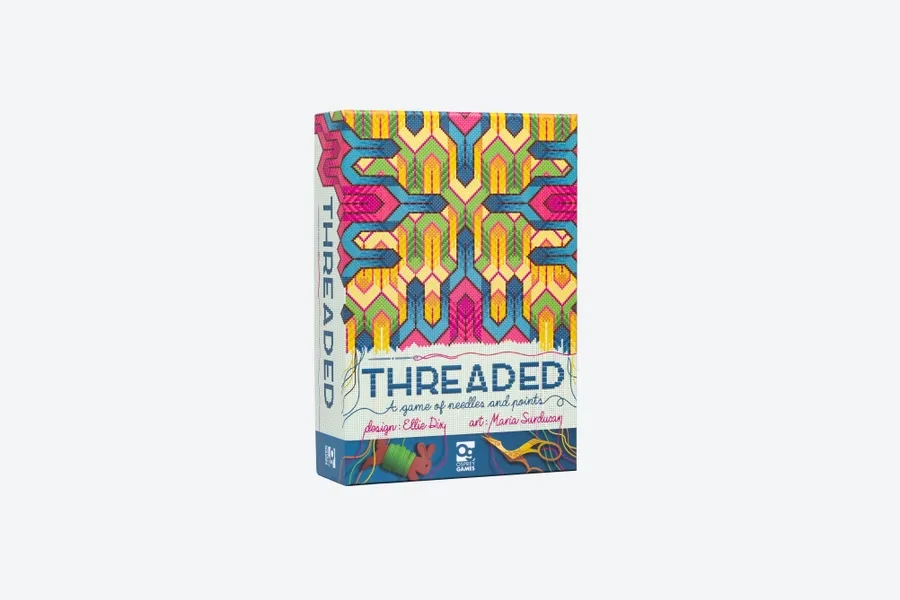
Firstly we’re moving from doughnuts to Bargello, and no, I don’t really know what that was until I read the manual, but what I can say is that it reminds me very much of the gorgeously simple pixel art you would get in the days of 16 bit videogame consoles. This style alone, and the entire graphical design package across Threaded presents a plethora of beautiful designs when the game is in full motion, and as you progress to the end, you’ll get sad because you’ll need to put the rainbow loveliness of presentation away.
Threaded is a worker placement game with a twist. Its a game about having a things to do list and needing to queue up at certain shops to carry out your set tasks, but then you have to wait for your turn as you opponents get to do what they need to do, while you’re standing their hoping there will be enough left for you so you can tick something else off the list. You’re also limited in the number of helpers that you can place, which can often mean that even though you’ll never be spoilt for choice, you’re pushed into decisions where you’re deciding what you’re willing to miss out on in this round but still be making progress. Its is not unusual to end up planning what you are doing for future rounds, muttering incoherently, and possibly shaking your head, tutting and then frantically smiling as it dawns on your that things are actually alright, and you can wait that one more turn before you do anything else.
:strip_icc()/pic9449314.jpg)
Threaded wants you to think this is all gentle and full of whimsy and it tries to do that by having funny names for the shops around the board, a veritable feast of puns that honestly trick you into thinking this is going to be a piece of cake, or thread, wool or some other thing. Instead what you have here is something that requires thought and planning as you try to create tapestries to score. Take the needle, you add cubes of thread to the needle that you can then trade in to create one of the tapestries on offer, but you can only use the thread in the order it leaves the needle. It’s a small addition that I consider to be tactically brilliant. It’s like resource management except your caught in some kind of limited spatial puzzle. Yes, having a grey, yellow and green thread on your needle is great, but you realise that you’ve put the yellow and green in the wrong order and you now have to spend time on another shop to be able to fix it. This isn’t about taking resources from a pile, it is much more elegant than that. Even the threads that aren’t on your needle are limited to a maximum of four pieces per colour, another restriction that forces you to think.
:strip_icc()/pic9449316.jpg)
It’s also not about creating as many tapestries as you can, but more about the commission cards that you collect during the game that are then used as score multipliers at end game scoring. Commission cards are restricted to four, and each of them will have their own point scoring condition based around colour combinations. It becomes vital that you maximise you creations against the possible end. Once a player has created their fifth tapestry then the game finishes up and the tally is taken. Often it makes more sense to take time and concentrate your points over splashing the thread all over the table. You end up rereading the commission cards again and again as you get closer to the end, just making sure you’re doing every thing you can to get the best out of what you have sewn.
:strip_icc()/pic9449317.jpg)
The charm keeps on going, the well illustrated equipment cards that give you additional bonuses for each of the shops, the thread cube dice tower that you build and then use to select threads as you play, the first player token that you can make yourself if the mood takes you. The box isn’t a huge behemoth and everything fits snuggly once you’ve packed it away. It all adds to the overall charm that threaded brings to the table in vibrancy. There has been time spent on the rulebook to make it a place of instruction and learning instead of unanswered frustration, even though the game is more complicated that the theme suggests this isn’t entry level worker placement by any means. It will surprise those who are expecting something light and breezy with an inevitable point salad at the end. Like any slightly crunchier game, there is a reasonable amount of space taken up by the game once you lay out all of the shops, player boards and components. Those looking to play at bigger play counts will need to bare that in mind. Those with smaller counts will be pleased to see the presence of space blockers included as part of the game. All in all, Threaded does its best to present a premium experience on the table. All in all, I think its a rather delightful way to spend some time you cheeky little sew and sew.
Designer – Ellie Dix
Art – Maria Surducan
According to the Competition and Markets Authority. Receiving any kind of item in order to produce a critical piece constitutes as an Advert and must be labelled as such. Therefore please consider this piece as an Advert as defined by the CMA. This review is based on the retail version of the game provided to us by the designer and publisher. We were not paid monetary compensation for this review. We give a general overview of the gameplay and so not all of the mechanical aspects of the game may be mentioned. The majority of the games that we are play are going to take a reasonable number of sessions and playthroughs to fully understand every possibility that they offer. We hope this write up gives you an idea of whether or not this game is something that you will consider playing or even add to your collection. Even if we don't like something, hopefully it helps you to decide if it is something that you should find out more about. We always suggest you check out a gameplay video to give you a better understanding of the game as it is played. If you would like to support more content on the blog then please consider backing us on Patreon. www.patreon.com/werenotwizards