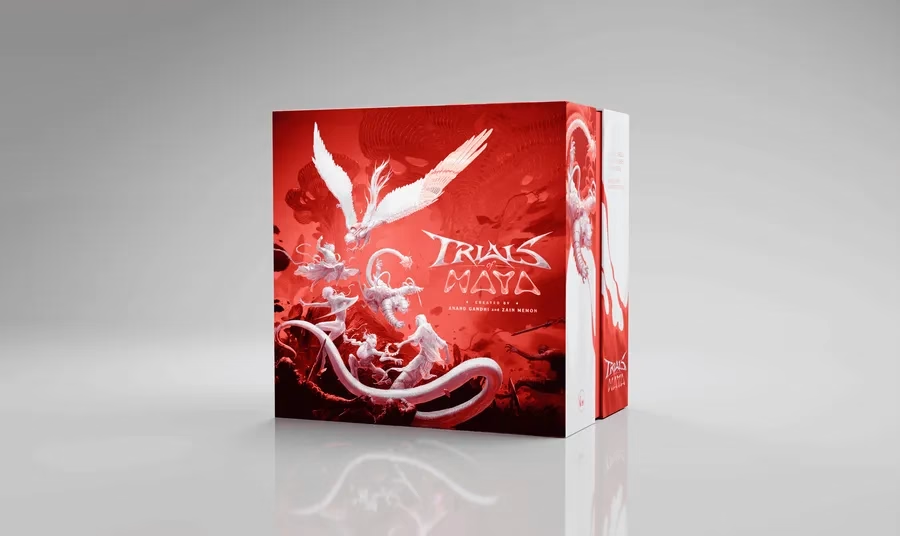
It’s a big box. Probably bigger than it needs to be. The player boards are THICK, probably thicker than they need to be. Everything about Trials of Maya is more than it needs to be, and I don’t know if that’s a good thing or a bad thing. If we’re talking about creating an impression, than Trials of Maya has certainly done that. I’ve never once opened up a game box to discover a completed book about the world Maya resides in. Like it or otherwise, that alone shows a relative large amount of commitment that this is obviously not intended just to be something that is put out there to do some quick money cash grab option. The design team are based out of India, and the cultural differences here are apparent in terms of the theme, presentation and mythology. It’s also how clear in the communications with the team. These are people who aren’t backwards in coming forward about their excitement for the game. It’s refreshing to see a company not skirt around the fact that they are trying to push and promote this new IP.
Trials is a MOBA, and for the uninitiated, I’ve always treated them as a short form war game, where the idea is to control areas, upgrade your units and ultimately destroy the enemies base. Generally you don’t play MOBAs in a campaign mode, you’re likely to be tallying up the wins that you have over a period of time, as opposed to making overall progress against the big bad. Trials of Maya tries to emulate this as best as it can within the cardboard space, where rounds consist of you gaining energy to be able to play actions from cards in your tableau. Energy is gain when cards slide off your own player board, which we like very much thank you. Then using this to move your character, trigger special abilities or attack either minions or your opponents on the board. While watching your character slowly grow and upgrade their powers.
Presentation in Trials of Maya borders between being excellent and overplayed. The box is huge, and I almost fear for the size of the box that the finished product will arrive in. Trials arrived with 4 heroes in the prototype, and apparently there’s going to be another nine contained within the final game. The current game box is at least 30cm x 30cm, and the trays within the box are solid plastic, and I mean solid, these aren’t the kind of trays that will buckle under a couple of months of continued use. These will be here in a couple of years if you used them as furniture. Game trays are thick and labelled with what they are meant to be used for. Tokens are chunky, the towers come with hilarious suckers on the end, and the miniatures are bigger than what you get in the likes of Godtear, probably closer to the type you see in Dark Souls or Elden Ring. When they are on the table they are noticed. Player boards are almost too thick and chunky for their purpose. Again everything just falls on the side of being a little bit ‘too’
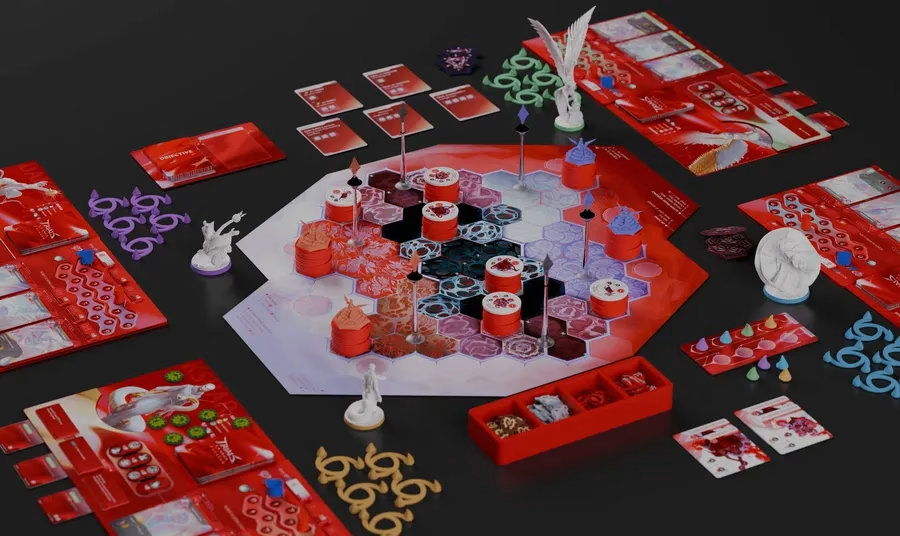
When you set up Trials of Maya, you’re going to need to put out the big table as it does take up a lot of space, even for the smaller 2v2 skirmish game version. Each player will have their own board, but you’ll need space for the draw deck, the objective deck and also for each player’s collection of tokens. Set up is going to be one of those situations where experience with the game will drastically reduce the set up time, and you’ll probably end up doing what I do in these situations, which is to make sure that you can literally hand over a packet to each player that contains everything they’ll need for set up. Trials gives each player their own miniature box, and therefore make this part a lot easier. These aren’t just sealable baggies, they’re the kind of boxes you usually see displaying a watch. Some sat down and thought hard about this and again, it links back to a mixture of commitment and enthusiasm.
Learning isn’t much of a chore, and it’s helped that we’ve got a solid rulebook, a set up for each of the modes, a reference rulebook and player aids. All of these are designed to get you playing, remind you of things you’ve forgotten and try to get you to the point where the player aids are enough to keep your going. I’ll be honest here, good rulebooks and crowdfunding have always been wary bedfellows, almost becoming a prerequisite that the rulebook is a work in progress as opposed to something that can be displayed with pride and confidence. I’m certain there will be changes to the final version as expected but they’re a good ninety precent there.
The main thrust of the game is balancing when you play and what you play, which will be based on the card you play deciding when you take your turn, and how the cards you have slide away to give you more energy for the round. Like the source material the heroes are a mixture of fragile hit shatter fast move cannons and tanks that can’t do much but sludge, and take their time, but trundle and win and are exciting enough in their own space. One of the key parts of the game is how you treat the secondary enemies, or the minions, as they start out causing trouble for everyone, but you have the chance to take them over and make them your own, turning them into recruits to help your own cause, trying to stall the path back to your own base. I wish their recruitment cycle wasn’t so quick though, because unlike the video game cousins, space is restricted and minions spend most of their time dying.
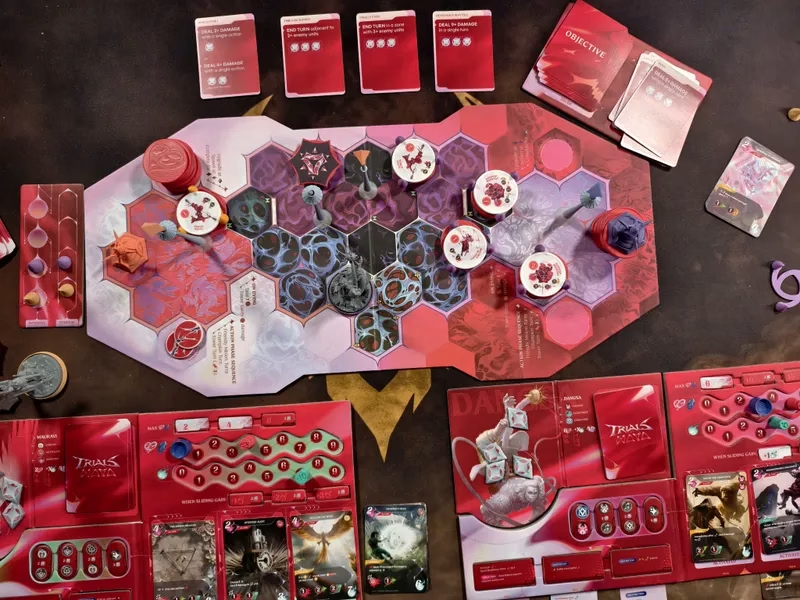
You don’t get the real chance to easily clear the path and then take up the advantage before the respawn part happens again. It’s unfair if I don’t mention the very clever mechanic on how health is treated, where beaten enemies health ends up in a pool that you can use for your own minion party, and this is where rather than saving up health to launch a chonk might make sense, but it makes more sense to send out annoying one hit wonders as they do the same job of holding up any ongoing charge. There’s a frustration there that has a habit of changing a potential quick clever win into back into you fighting your way onwards to your opponent’s base, and I think it is something that could be improved and simply done by increasing the size of the arena or increasing the cost to spawn ally minions to make them more special and less expendable.
Trials of Maya also falls into the trap of having spaces where the characters fit exactly, and this is an issue when one of the major parts of the game’s strategy are the advantages gained based on the types of spaces you occupy. High ground, low ground and traps can all be easily covered up when the game is in full flow, and you might as well just explain you battle plan after the fifth time of picking up minions and opponent just to double check what is under the space. Its the kind of issue that comes from designers who have over exposure to their own game and know the layout of their boards down to the symbol but doesn’t help those learning to play, and it certainly doesn’t help a game where you need to be able to read the board as easily as possible to formulate your next move. It is surprising because the player board themselves are a mine of open and obvious information, and you can see what upgrades your opponents have garnered relative easily.
While I really like the idea of life points being represented by chips, the sculpts on the chips used are uneven and can easily fall over when being moved by a ham-fisted old man. I appreciate effort that has gone into making something unique, but I think they should follow the Chip Theory Games path and just use normal, dull and boring poker like chips that don’t scatter like coins in a rushie at a wedding. This is something that can be easily fixed, and I hope it is as we really don’t easily solvable frustration when the presentation is doing so much decent heavy lifting.
Oh that presentation. This isn’t a passion project, because it suggests a mere number of heated moments where something is created and loved before it fizzles and settles down. I feel like I’m picking away at a bone trying to find the last meat of criticism here, while ignoring the feast that has been presented in terms of colour, mythology and world building. Trials of Maya appears to be something that is building a full foundation on top of which an entire genre is trying to sit on, like the space turtle in The Discworld series of books. In which this game is going to be a small part of a much larger story. It’s a brave route to take, as we’ve been here before where worlds are born in explosions and end up in sloppy and disappointing expansions. It’s difficult to smack down on someone who wrote a book about the world you are battling in. At the same time, there’s so much here my brain was maybe hoping for something that was more a starter than a fifteen course main meal.
It works though. The card play, the balance between playing for energy and playing to attack, the levelling up, the grin when your planned attacks work out, and the grimaces when you are thwarted. It continually goes back to one thing. The designers know how a MOBA should work, and have done their best to demonstrate to you that they know how a MOBA should work. You’ll over analyse and hold back or go in full attack with a screaming abandon, knowing that defeat is just a temporary thing. Dusting yourself off to head back into the field again.
Here’s the rub. Trials of Maya takes an entire evening to play. It’s like one of those event games where you’ll be planning when you play. When you put it alongside other small group skirmish games like Godtear, which has the same asymmetrical characters and an established character but can be done in a lot less time, then you’ll need to make a decision involving some commitment. The people that I know who play MOBA’s put the hours in, often hundreds to find and crack the meta, work out the best strategies and opening moves. Even at your most prepared you’re taking a chunk of time to set up, if you’re playing an explaining game then you’re looking at a hour before you even get to the main battle. There’s a lot here, and even though the rulebook is one of the best I’ve seen from a crowdfunding campaign, its going to take time to take in, cogitate and digest. I don’t even think I’m close to qualified to say whether or not a like it or not, because I haven’t had the time to go through the characters, to learn the combinations that work best, to see how it is best to play the heroes you’re playing with.
I couldn’t imagine taking this to the games club and seeing who turns up and is ready to play. It needs organised and consistent play to get the best out of it. It’s going to be your group game for a while, but the players have to be aware that there’s no campaign. Just like chess, you’re playing to learn, and playing to get better. I almost wish for a throwaway starter version, a ‘get to know me’ scenario which takes you by the hand and gives you a glimpse at the potential wonder on offer here. You can’t fault the time, the commitment, the work that has gone into this product, and it deserves that to be repaid by the group who will grasp it to their bosom and be glad they found something where its clear someone gives a damn about lanes and battling and minions and Red. There’s a lot of red. It’s probably what was left after they ground down their hearts to make this. So go in with your eyes open, stare at the art and presentation, but keep in mind this might be a trial in itself to fully appreciate it.
You can find out more and back here