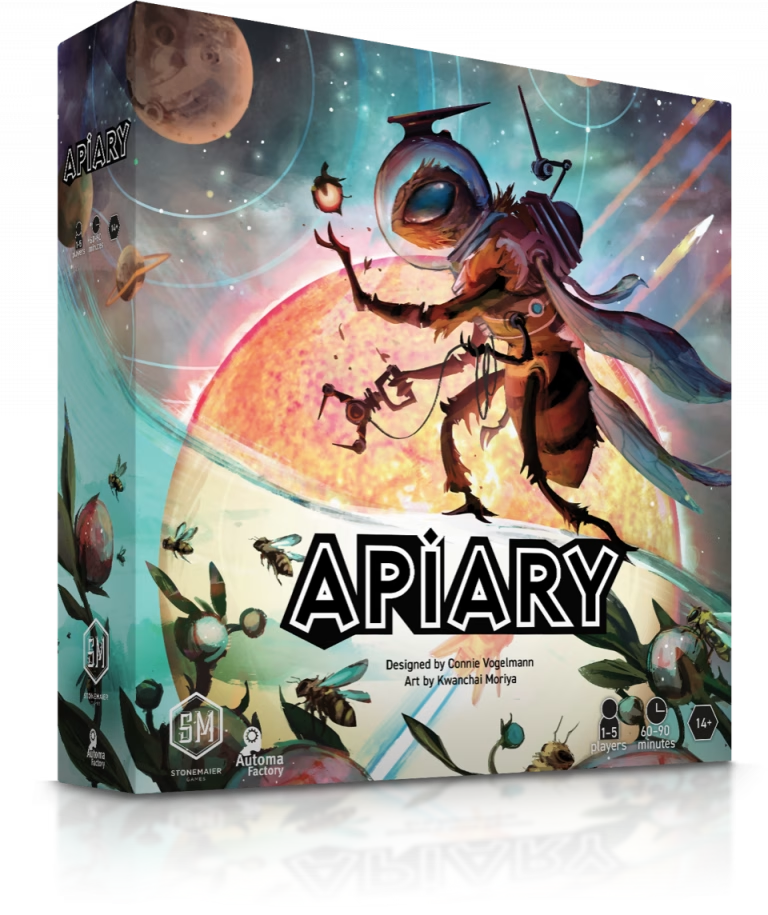
My scepticism with the Stonemaier range of games has always been the same old question, ‘how much interactivity do the players have?’. For several of them, the level of interactivity can be small to almost nothing. I have often commented that you could play the likes of Wingspan with ten or twenty players and never really see your actions being inhibited beyond the potential card choice. Tapestry is an individual buffet of delights, even the classic Scythe can be lonely at the lower player counts. That would never really make me refuse playing them at the table, as they are all fun games in their own right. Which brings us on to Apiary, Connie Vogelmann’s game design all about Bees in Spaaaaaace (and no, I’m never giving up that, ever). As a futuristic bee, you’ve been tasked with building up your own colony, exploring planets and using base materials to trade into wax and honey so you can afford the very expensive gameplay upgrades.
 On first impressions, Apiary has the look of a normal Euro game, with the main board being split into several different sections, all with their own actions and point scoring purposes, there’s colourful iconography and a mixture of space and plants which has you intrigued from the outset. The you’ll get your own base in which to start building your own colony and from the start you’ll notice that your board is different from everyone else, with slightly differences in how you can score points and bigger differences in how your starting colony shape will bee from other players around the board. It reminds me of Tapestry with the differences in the governments that you start off with. In a similar vein, you’ll need to use the same main board as everyone else to maximise your own little slice of space.

Normally in worker placement games, you pick a space, that space has an associated action, and you take that action and grin and someone across the table curses you for taking their spot and taking their coveted action. You’ll then have to wait until the next round until you carry out some revenge and thwart their plans. As per the rule of sod’s law, someone else will take that coveted space. With the likes of Viticulture, that particular bug bear was sorted out with the introduction of the Grandé worker, who could be placed on any occupied space but lost out on the bonus.
 In Apiary the entire structure of worker placement has been rewritten to not only remove the blocking of spaces but also removing set individual rounds. I don’t remember playing a game with a similar set up before. To help you understand, each worker is a space bee with a cube for the main body and on each side of the cube is number from 1 to 4. The number represents your power and how effective your action is when you place it in a particular space. It decides how many spaces you can explore on the exploration section, it decides what level of buildings you can buy, it ultimately decides when the game finishes as well. When someone decides to usurp your space to take an action, then your Bee grows in power, which is welcome, sometimes you’re actually wanting another player to take your space so you can be upgraded. Placing a power 4 Bee on a space will often grant you a powerful variation of the action you take, or an alternate action. Bumping off a power 4 Bee results in it going into hibernation, adding it to the hibernation section and progressing towards the end of the game, which is triggered when all the hibernation sections are full. It’s an inevitable part of the game but the fact there is specific player agency for all players involved makes this intriguing and unusual, and in my opinion, quite special.
While this isn’t a revolution in worker placement, it creates a continual game flow which is only interrupted when you can no longer place any bees and you have to recall them back to your hive, at which point you are normally rewarded in resources based on the tiles that you have placed in the space station. Turns don’t lengthen as the game progresses, even though you can create sprawling stations that add more points to your end game total. The last couple of turns evoke a tension, as you can easily end up in a place where you need to place a Bee in a certain space, but don’t want to place it as it forces another player to hibernate their bee and take you one step closer to the game end. At this point the table might be enveloped in glorious analysis paralysis.
 Apiary is about building up the power of your Bees towards ownership of honey and wax, which are currencies that allow you to afford the best in upgrades and are essential if you do want to win the game. Though I’ll never get over the fact that wax aren’t little hexagons and the honey isn’t in a classic hive shape. There you go. Alongside this, there are cards that you can purchase to bring in additional bonuses as you play, ultimately adding more mayo to the point salad.
My concerns are few and based entirely on circumstance. I think that if you end up with a starting tile that doesn’t work for your strategy you can feel that you are fighting every step of the way to gain your points. While there is an emphasis on the importance of the Queen’s favour track, in the games I’ve played including on Board Game Arena, I’ve never they’ve had as big an impact on the final scoring as they are made out to be. I would also like to see thicker components, especially for the hive modules. It seems to be lacking the overall chunkiness that I’m use to seeing in the likes of Tapestry, but that is more of a preference than a criticism.
The entire package is wrapped up in a delight of illustrations from Kwanchai Moriya. It really has brought an unusual theme to life and works extremely well with the game vision that Connie Vogelmann has created.
Apiary’s main strength is how it diversifies from the expected worker placement formula, and in turn how it offers a such a variety in what each player has to work with, reminding me of the Mama and Papa starting cards in the original Viticulture. It offers a Euro type worker placement experience where player interaction is not only present, but an essential mechanic in how the game plays out. It provides a fresh experience for someone who likes to build an empire but is maybe a bit tired of blocked spaces and impeded plans. The pigs can stay at home, I prefer the Bees now.
Find out more by visiting https://stonemaiergames.com/games/apiary/
According to the Competition and Markets Authority. Receiving any kind of item in order to produce a critical piece constitutes as an Advert and must be labelled as such. Therefore please consider this piece as an Advert as defined by the CMA. This review is based on the retail version of the game provided to us by the designer and publisher. We were not paid monetary compensation for this review. We give a general overview of the gameplay and so not all of the mechanical aspects of the game may be mentioned. The majority of the games that we are play are going to take a reasonable number of sessions and playthroughs to fully understand every possibility that they offer. We hope this write up gives you an idea of whether or not this game is something that you will consider playing or even add to your collection. Even if we don't like something, hopefully it helps you to decide if it is something that you should find out more about. We always suggest you check out a gameplay video to give you a better understanding of the game as it is played. If you would like to support more content on the blog then please consider backing us on Patreon. www.patreon.com/werenotwizards