

Emberleaf is Frank West getting back to “pre-The Isle of Cats Frank West”. We’ve only really seen hints in games like Race to the Raft and Isle of Cats Duel, where it was clear that through all of the simpler game play, they were slight hints that more complicated mechanics were possibly desired. Maybe some were sitting on a drawing board waiting to see the light of day and ended up joining the pile of ideas that became Emberleaf, I guess we’ll never really know. I wonder how much of Emberleaf is James Tomblin and how much of it is Frank, jumping on the raft from the Isle of Cats and deciding it was time to let some of his heavier thoughts get to the table again.
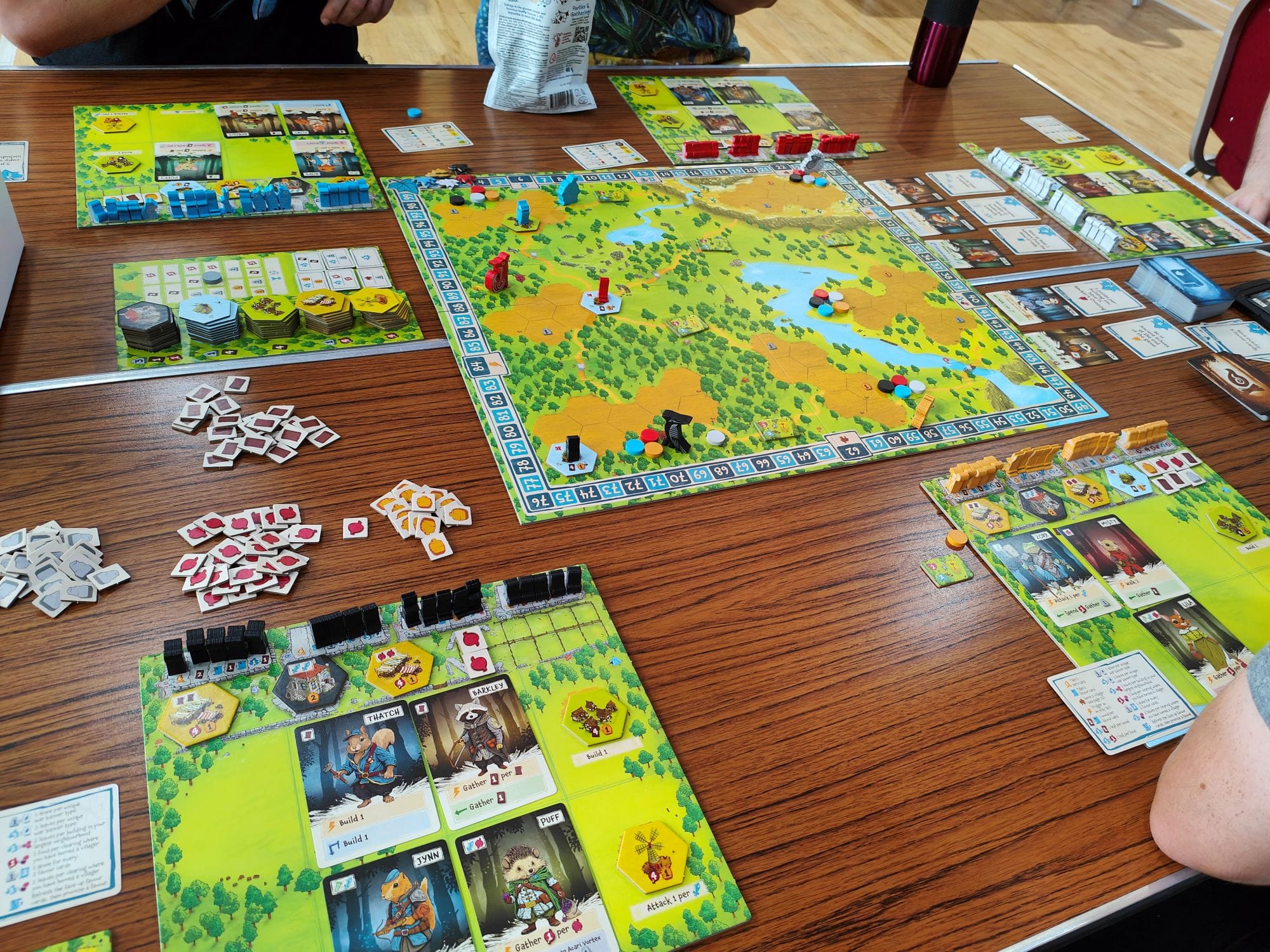
Looking at the board, you’d be forgiven for thinking this a riff on Root. I’m only making that comparison because you’ll all be making that comparison when you look at the board. You’ll say to yourself, “Oh This looks like its riffing on Root”. There’s paths and forests and animal shaped meeples and there’s a hint of asymmetry, but no factions, well, no real factions to speak of. Emberleaf is about points instead of win conditions, and players don’t battle each other, but the resident evildoers who have taken up camp across the very colourful map. You get a player board with little animal meeples and tiles that cover spaces. You get resources that are begging you to be upgraded. There’s animals in costumes on the small deck of cards that you play with. On the face of it, its not unacceptable to think this could just be a box ticking exercise to make you want to like Emberleaf out of the gate. I’ll be honest, it does a good job of sparking that slither of interest. I’m intrigued.
 There’s two main areas to focus on when your playing. There’s your own little world on your player mat which serves as a place to keep your played cards ready, and above is an army of small animals and a row of upgrader inhibitor tiles, a direct indicator of how the game is progressing for you. These tiles unlock more resources or give you the ability to have more cards on your player board, and should be ignored at your peril. While the smallish animal tokens will settle down on clearings on the main board once you play any kind of building tile into that area from your board or the main pool. Every little animal that settles results in bonus points for yourself, whether it be resources or an extra action tied into the current state of play for you.
There’s clearings that house the ‘big bad warbands’ that need to be defeated in one off attacks and require simple maths to negotiate. This part of Emberleaf isn’t very Root, but it is very Military Tapestry. You know the bit I mean, the central tile area that I generally ignore in Tapestry, that allows you to conquer areas and lay down your own tiles and towers to control the central map. It’s very much like that. With Emberleaf you are laying tiles to fill up clearings to win one of the six end game bonus markers, essentially the games main timer. The other way to gain a marker is by clearing enough enemy units to move your token down the war banner track. It opens up a two distinct ways to move the game forwards, though in my own experience you’ll want to have a mixture of both, as some of the more scarce resources are easier to gain through combat, and are essential when it comes to upgrading your player board. At the beginning of the game, where warbands and clearing spaces are plenty, you’ll be happier to lead the charge and set down buildings. As the game progresses, you can sometime feel the need to hold back, as placing your next building down might mean one of your opponents can add the last building and therefore claim one of the bonus markers that brings the game closer to finishing, and you’ve still got so much going on that you want to grab points for. It pushes a conclusion to a game that forces you to make choices to optimise your overall points.
 Your second focus is going to centre around the card dancing. It’s like a conveyor belt of screaming animals that give their all as they cascade off the edge of the board in the abyss, promising to do better, begging to be brought back from your hand. Your player board works as your own tableau upgrading space, where you decide your actions by playing cards and dancing them. Also where you store your critters who will be homed on the main board, unlock additional resources that can be used on your turn hidden under more expensive tiles. Take an action that demands payment and you can use any of the printed resources to pay for it. Paying for builds requires payment in actual physical resources. For the first couple of rounds this might cause a slight confusion, and the occasional second guess. Once you grasp it, becomes second nature. My only concern regarding resources is the scarcity of the beehive / honey tokens, which are given out like special little prizes for those who do very well, but are fundamental for building some of the main structures that are needed to progress in the game if you are upgrading your player board. I felt a couple of times I was veering away from my own plans to carry out tasks to gain them, as they are tricky to come by when you are just playing the game itself which is occasionally frustrating. It makes you realise that you can’t achieve everything on the board and you need to diversify on every game to succeed.
Card dancing is moving cards from left to right, and depending on the card’s symbol, the card will then activate an additional action when it slides or when it drops off the board to go back to your hand. Each of those cute but angry animal cards you have in your hand will either have actions that benefit you straight away, or have more benefits when they go through the cascading dance action. You’re more likely to dance less, but when you do, you’ll reap the rewards of the cards you’ve played previously and normally end up taking several actions at once. There’s the occasional confusion about how resolve as they move and drop off, but again familiarity will put that to bed over certain rounds.
 Card Dancing acts as a small generous reward for previous planning and work, and there is a satisfaction when things go to plan, as well as comedy moments when you realise that you’ve placed your cards in the wrong order to optimise them fully. Often I found myself holding back from creating complicated cascading actions to make sure that I was chipping away at the goals on a little and often basis. It is such a unique mechanic that I don’t remember playing a game that had something like that before. Coupled in with the ability to add another four cards to your team, it does increase the levels of replay on offer. Be wary in your first couple of games, grasping what each card does can take some getting used to.
In typical Frank fashion, there are goal cards to gained, just like the lesson cards from previous games. It becomes imperative to make sure that you are collecting these and scoring them as you can, as they can make a huge difference to the end game as we found. It’s not unusual to see one player trailing the pack to have them unleash a flurry of points at the close of business and therefore snatching victory. Sometimes, its worth holding back on the building and battling to make sure you aren’t ignoring these games changers. It is easy to forget that they are game timers as well as overall goals and rushing to battle might leave you short in points and therefore victory.
As a package it arrives as a lovely looking game, with a colourful table presence and components that sit well within the City of Games universe, and more importantly your table. Make sure it’s the extended table though, as on higher player counts you need a fair amount of space to allow for player boards, chits and character cards, as well as lesson cards and resources. In my opinion Emberleaf best serves when its player count is three. The game rattles along nicely without too much downtime, and prevents situations where you are having to continually adjust your plans to counteract the three or four turns that have occurred since you last got a chance to play. At higher counts you feel you are making more of your decisions on the hop, and there’s little point in paying attention to the game board until it is your actual turn, and you see what you have to work with. After all, there is only so much planning you can do on your own player board before you end up staring and waiting.
Emberleaf is very special to me. When I loaned it to a friend recently, I was fussed about getting it back into my collection again. Normally in these circumstances, I end up telling people just to keep the game, because the game was fun, but I was happy with the time I spent with it to pass it on to someone else. With Emberleaf, I want to get it back to the table again. To be immersed in the world that Frank and James have created. I want to be building, and gathering resources and fighting warbands. But mostly, I want to be dancing again, cards in hand.

This review is based on the retail version of the game provided to us by the designer and publisher. We were not paid monetary compensation for this review. We give a general overview of the gameplay and so not all of the mechanical aspects of the game may be mentioned. The majority of the games that we are play are going to take a reasonable number of sessions and playthroughs to fully understand every possibility that they offer. We hope this write up gives you an idea of whether or not this game is something that you will consider playing or even add to your collection. Even if we don't like something, hopefully it helps you to decide if it is something that you should find out more about. We always suggest you check out a gameplay video to give you a better understanding of the game as it is played. If you would like to support more content on the blog then please consider backing us on Patreon. www.patreon.com/werenotwizards